
Parrhesia παρρησία
Parrhesia means frank speech: saying everything, and saying what one holds to be true even when it involves a risk to oneself. The concept was central to Athenian democracy and gained renewed significance through Michel Foucault’s late lectures on truth-telling.
Saying everything
The word is made up of pan, “all”, and rhēsis, “speech”. In Athens, parrhesia was closely tied to citizenship. Whoever was free to take part in the affairs of the city was also free to speak their mind before the assembly.
But parrhesia was not the same thing as freedom of speech. The historian Polybius distinguished between isegoria, the legal right to take the floor, and parrhesia, the political practice of actually speaking freely and standing by what one says. In Euripides’ tragedy Ion, and in the image of Pericles as first among equals, the two are still intertwined: to be a citizen is to have the right to speak, and to be the first is to tell the truth about what the city should do.
Foucault and the truth-teller
In his lectures at the Collège de France in 1982–1984, Michel Foucault returned to the Greeks to write the history of truth-telling. He describes how parrhesia changes during Plato’s lifetime, at a time when democracy in Athens first fell to the Thirty Tyrants and was then restored, but not as it had been. According to Foucault, the concept undergoes four shifts:
- It is generalised: frank speech is needed not only in democracy but under every kind of rule, including that of the tyrant.
- It becomes ambiguous: when everyone can speak, the flatterer can also imitate the truth-teller.
- It splits: speech is no longer addressed only to the city as a whole, but to the individual soul, and parrhesia becomes tied to psychagogy, the art of leading souls.
- The question becomes who can be a truth-teller: it is no longer enough to be first among equals.
The philosopher against the rhetor
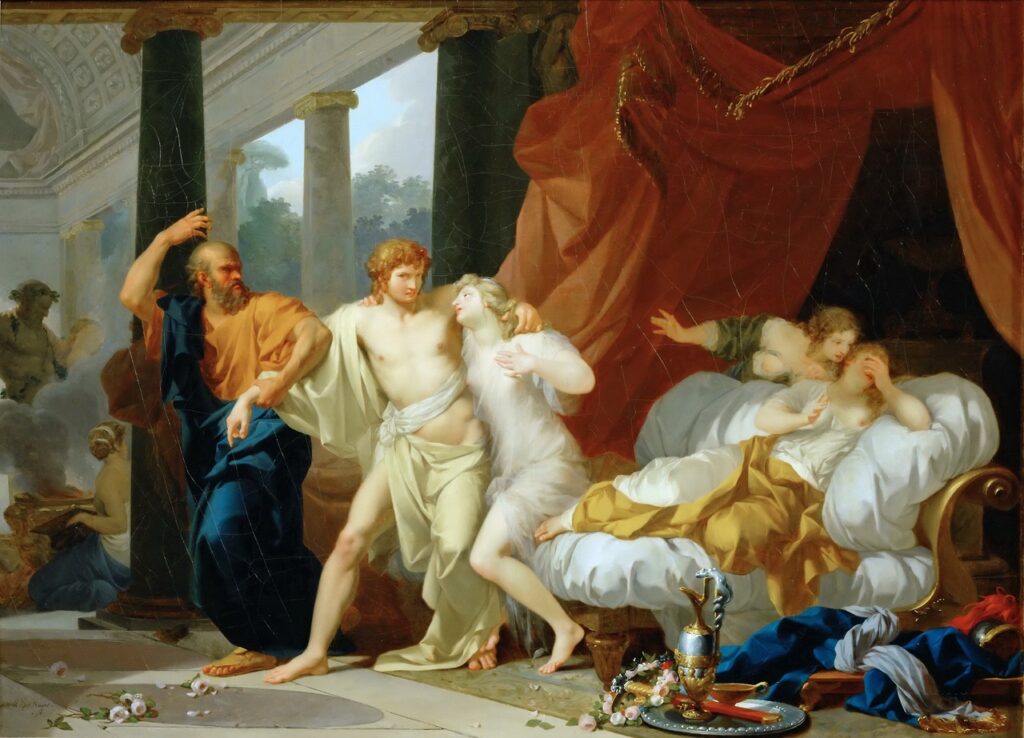
It is here, according to Foucault, that the conflict between philosophy and rhetoric arises. Socrates becomes the new truth-teller. He walks around the city saying uncomfortable things to everyone, to the poor man in the gutter as well as to the tyrant in the palace, and he does so right up to his death. The rhetor, by contrast, speaks in the agora or in the court, with a definite aim, and persuades the audience without being changed himself.
In the dialogue Gorgias, Socrates says that whoever is to test whether a soul lives rightly needs three qualities: knowledge (epistēmē), goodwill (eunoia) and frankness (parrhēsia). Compare the three qualities Aristotle later demands of the speaker’s ethos: virtue, practical wisdom and goodwill. Goodwill is found in both, but where rhetoric has practical wisdom, philosophy has frankness.
Is parrhesia philosophical or rhetorical?
Foucault has been criticised by rhetoricians for making parrhesia a philosophical rather than a rhetorical concept. But his reading offers a different way of reading the history of philosophy than the usual one. Rhetoric is here not democracy’s favourite child, the art of all free men, but the aristocracy’s last attempt to preserve the contest, agon, in which some can become the first and rule over others.
One can nevertheless ask Foucault whether the opposition between philosophy and rhetoric is not built into democracy itself. When truth is no longer decided by the speaker’s position, by the oracle or the king, but becomes a matter for debate, the possibility of speaking falsely also arises. Two citizens can lay claim to the same plot of land, and both cannot be right. Frank speech and flattery are born together.
Parrhesia or pharmakon?
Jacques Derrida reads the same dialogues differently. In “Plato’s Pharmacy” (1968) he shows that writing in the Phaedrus is described as a pharmakon, at once remedy and poison. For Derrida, it is not rhetoric that must be excluded for philosophy to begin, but the sophist, the false philosopher, and that boundary can never be drawn once and for all. Read more about sophistics.
Truth-telling, sophistics and the rhetoric of democracy are questions I keep returning to in my research.
Questions
What does parrhesia mean?
Frank speech: saying everything, and saying what one holds to be true even at a risk to oneself.
What is the difference between parrhesia and freedom of speech?
Freedom of speech, in Greek isegoria, is the right to speak. Parrhesia is the practice of actually telling the truth, and of taking the risk and the responsibility for it.
Where does Foucault write about parrhesia?
Mainly in the lecture series The Government of Self and Others (1982–1983) and The Courage of Truth (1983–1984) at the Collège de France, and in the 1983 Berkeley lectures, published as Fearless Speech.
Sources
Plato, Gorgias 487a, Phaedrus and the Seventh Letter
Euripides, Ion
Michel Foucault, Le gouvernement de soi et des autres (2008)
Jacques Derrida, “La pharmacie de Platon” (1968)