
Kairosκαιρός
Kairos is the right moment, the opportunity that must be seized when it arises. In rhetoric it means that a speech becomes good not by following fixed rules, but by fitting the situation, the audience and the moment. For the sophists, kairos was the very heart of the art of speaking; for philosophy, it became something that had to be tamed.
The Greek origin
The noun kairos does not occur in the Iliad, but the adjective kairios does. It refers first not to a moment in time but to a place: the point or seam on the body where a weapon most easily penetrates. From there the concept developed, for instance in Hesiod’s Works and Days, first towards the right measure and proportion, and later towards a contrast with chronos, time that runs on evenly.
Kairos also became a central concept of the so-called first sophistic, not least for Gorgias. Mario Untersteiner has argued that Gorgias’s view of kairos has an almost epistemological side. Because human beings, in their frailty, cannot know everything, we are bound to hold opposing views, dissoi logoi. It is in this condition that a speaker who seizes the moment can make something appear great or small, right or wrong.
In his critique of the sophists, the Athenian teacher of rhetoric Isocrates turns against those who treat the art of speaking as if, like the art of letters, it were a set of fixed and finished rules. The decisive difference, he argues, is that a speech only works if what is said is “fitting for the occasion [kairos]” (13). Isocrates is also said to have built his entire education, his paideia, around the concept. Plato, too, in the Phaedrus, counts among the things a good leader of souls (psychagogos) must master the ability “to know the right occasions for speaking and for refraining” (272a).
The personification
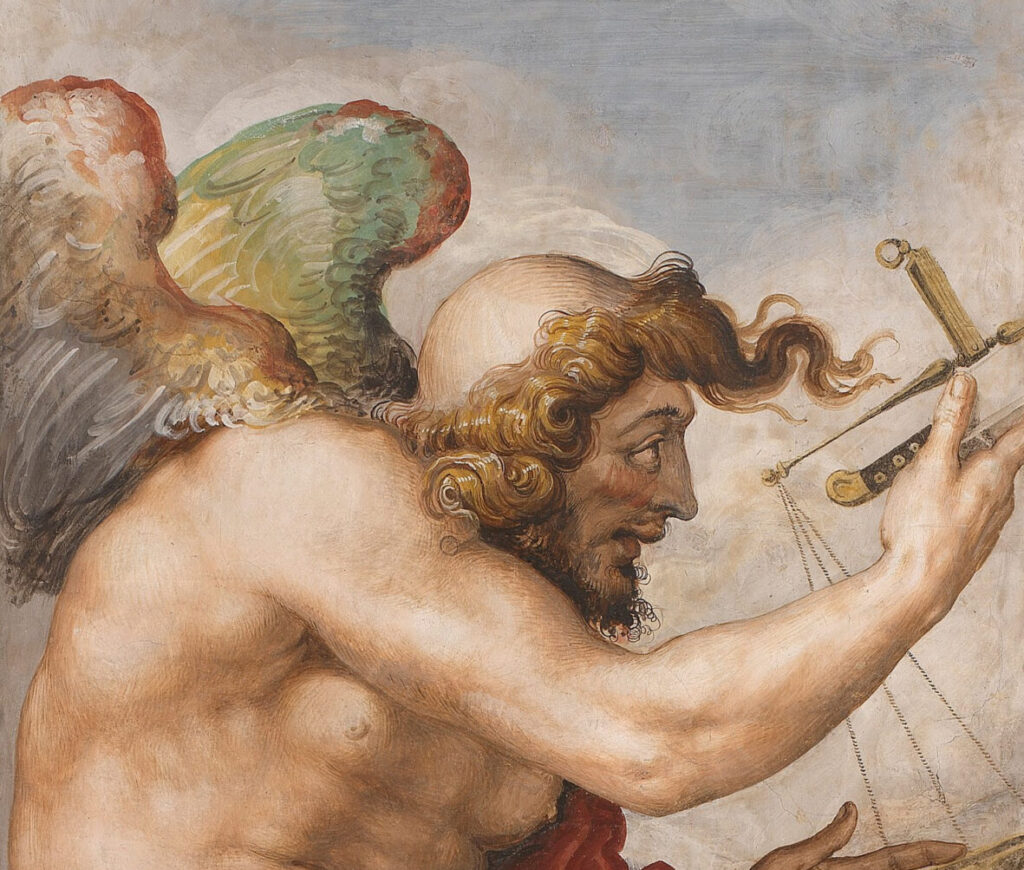
Because kairos is about catching the opportunity as it flies past, the concept was given its own figure early on: a young and beautiful god with winged feet, a long forelock and a bald back of the head. The most famous depiction was a bronze statue by Lysippos. The idea was that opportunity can be grabbed by the forelock as it comes towards you, but once it has passed, there is nothing left to hold on to.
Kairos and rhetoric
Within the rhetorical tradition, kairos can be said to have an ethical, an epistemological and an aesthetic dimension. The ethical concerns what is fitting in the situation, what the Greeks called to prepon and the Romans decorum. It is an ethics that judges what is right in a speech by the conditions the situation provides, rather than by eternal and given rules. It lies close to the epistemological dimension, since rhetorical knowledge only becomes effective at the right moment. The aesthetic dimension, finally, concerns the need for language to fit the occasion, what later rhetorical systems came to call aptum.
Just good timing?
Kairos is often understood as mere opportunism: saying the right thing at the right time in order to win. But in the tradition, kairos is just as much a judgement of what is fitting: what should be said, how much, and whether anything should be said at all. This is why Plato counts the ability to refrain from speaking among the things a good speaker must know.
Space and time
Barbara Cassin has shown that kairos is yet another point at which philosophy has tried to discipline rhetoric. Once again, Plato makes the first attempt. In the Phaedrus, a speech must be like a living creature, a body with both head and feet (264c). In Aristotle’s wake, speech then came to be studied as a fabric of tropes and metaphors, rather than as something that passes in time.
Cassin shows that this opposition is built into the word itself. Kairós and kaîros are two variants of the same word: the first means the opportune moment, the second the loops on the loom that separate the threads in weaving. Here she locates the difference between philosophical rhetoric, created by Plato and arranged by Aristotle, and its sophistic counterpart. The philosophical lays out the parts of a speech in space; the sophistic insists that language is only woven together in time, as words are spoken one after another.
Understanding how to identify the right time is part of my courses.
Questions
What is the difference between kairos and chronos?
Chronos is measurable, continuous time; kairos is the qualitative moment when something can be done or said with effect.
How does kairos relate to ethos, pathos and logos?
Kairos is not a proof in its own right but the condition for the others to work: an argument, an emotion or a self-presentation must fit the moment in order to persuade.
Who first wrote about kairos?
According to Dionysius of Halicarnassus, Gorgias was the first to attempt to write about kairos, but no one had managed to turn it into a doctrine.
Sources
Dionysius of Halicarnassus, On Literary Composition (De compositione verborum) 12
Homer, Iliad 4.185
Hesiod, Works and Days 694
Plato, Phaedrus 264c, 272a
Isocrates, Against the Sophists 13
Barbara Cassin, “Rhétorique, ou espace/temps”, L’archipel des idées de Barbara Cassin
Mario Untersteiner, The Sophists, trans. Freeman