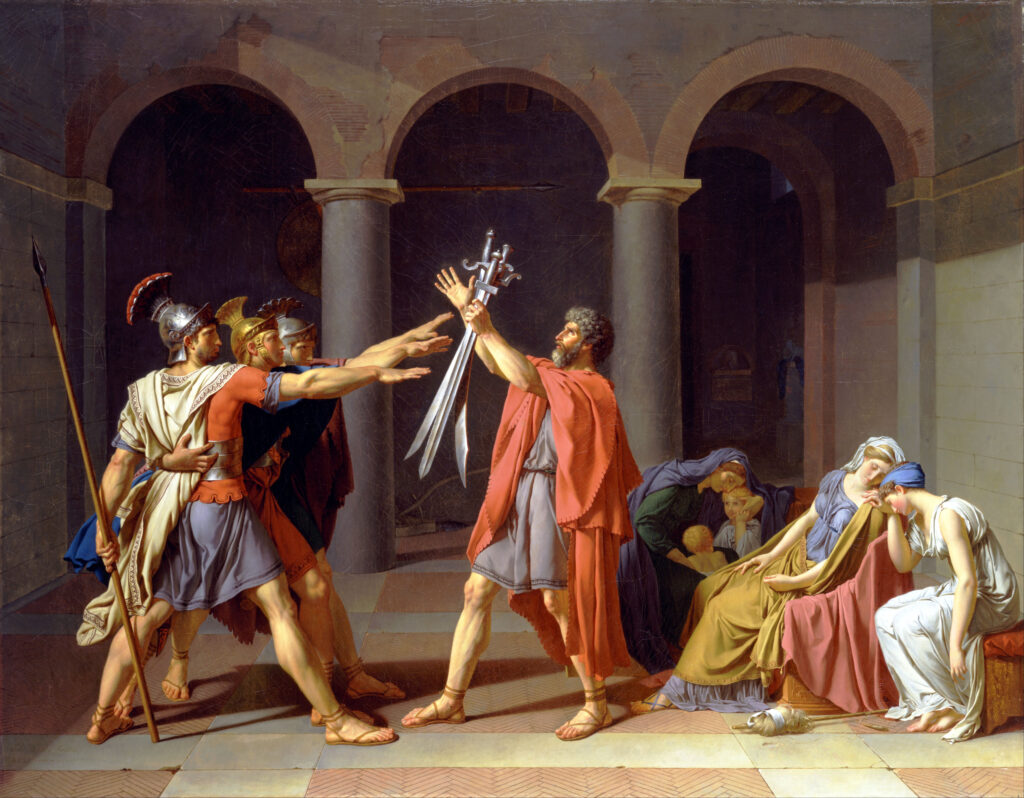
Pathos πάθος
Pathos is persuasion through the emotions a speech evokes in its audience. For Aristotle, emotions are not a lapse in judgement but what makes us change our minds and judge differently. The speaker evokes them by getting the audience to imagine a situation.
Emotions as reasons
Pathos is about the emotions that speech attempts to evoke in the audience. In the second book of the Rhetoric, Aristotle gives a lengthy account of how different emotions arise, because he holds that emotions are what “cause people to change their minds and make different judgements” (1378a).
How a speaker evokes an emotion
Here we learn, for instance, that anger comes from a desire for revenge against someone who has treated us badly, slighted us or ridiculed us. If the speaker wants the audience to feel anger towards an opponent, the speaker must therefore describe the situation so that the listeners feel that the opponent has treated them badly, slighted or ridiculed them.
The speaker does this by getting the audience to imagine a situation, often through a story or a trope, that can evoke the desired emotional state.
A common misunderstanding
Pathos is often confused with manipulation or sentimentality, as if emotion were the opposite of reason. For Aristotle, emotions are part of how we judge: someone who feels no anger at an injustice has not understood it. The question is therefore not whether a speech evokes emotions, but which ones, and on what grounds.
Working on messages that should move people without losing credibility? That is part of my courses.
Questions
Is pathos the same as playing on emotions?
Not necessarily. Pathos is evoking the emotions that fit the matter. It becomes manipulation only when the emotion has no basis in what is actually said.
How does pathos relate to ethos and logos?
They work together. An argument rarely persuades on its own; the audience also needs to trust the speaker and feel that the matter concerns them. Read more about how they are connected in What are ethos, pathos, and logos?
Where does Aristotle discuss pathos?
Mainly in Book II of the Rhetoric, where he goes through emotions such as anger, calm, friendship, fear and pity (1378a–1388b).